Use a graph to find a candidate answer. Then check the algebra, the domain, and what the question actually asks.
Original SAT-style teaching examples. Screenshots show actual calculator sessions; the complete steps and results are also written out. No sign-in is needed, and the practice below does not change account progress.
Exponential growth and decay: interpret the factor per time unit, and solve for when a target is reached. A factor 0 < b < 1 gives decay; use the original time unit.
Line–parabola systems: read the requested coordinate
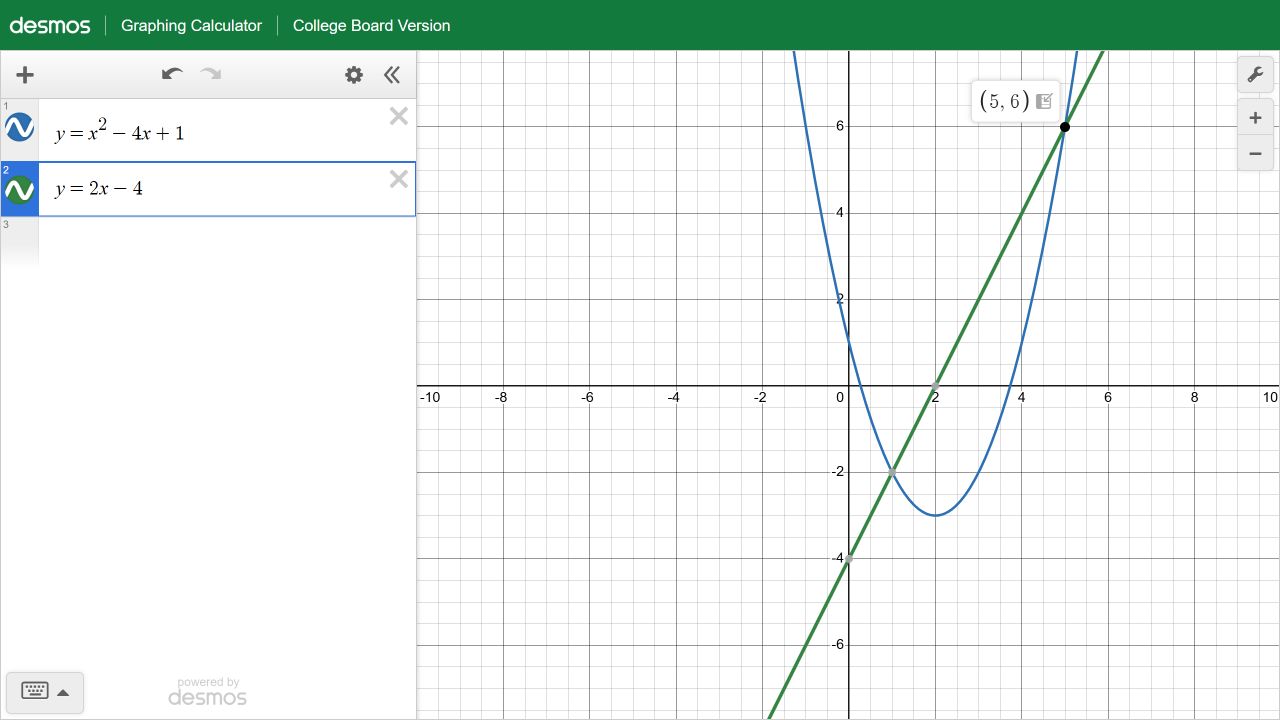
Solve y = x² − 4x + 1 and y = 2x − 4. What is the larger y-value among their intersections?
Why this approach works
A solution of a system must make both equations true for the same x and the same y. Graphically, that is exactly an intersection: the point belongs to both sets of solutions.
Setting the two expressions for y equal eliminates y. Factoring that equation finds all possible x-coordinates, and substitution recovers their y-coordinates. The calculator helps locate the points; the algebra checks that no real roots have been missed.
Enter these on separate lines
y=x^2-4x+1
y=2x-4
Do this step by step
Graph both equations on separate lines.
Select a curve and click both intersection points. They are (1, −2) and (5, 6).
Read the question again: it asks for a y-value. Choose 6, not the x-coordinate 5.
Set the expressions for y equal: x² − 4x + 1 = 2x − 4.
Rearrange to x² − 6x + 5 = 0 = (x − 1)(x − 5).
For x = 1, y = −2. For x = 5, y = 6.
Watch for this: One visible crossing is not necessarily the only crossing. Expand the window and use algebra when counting all solutions.
Exactly one solution: turn a visual idea into an exact value
For what value of k does x² − 6x + 13 = k have exactly one real solution?
Why this approach works
The equation asks how often the parabola has height k. A horizontal line y = k marks that height. Below the minimum there are no matches; above it there are two symmetric matches; at the minimum there is one.
Completing the square gives (x − 3)² = k − 4. A square can equal a positive number in two ways, zero in one way, and a negative number in no real way. This establishes the exact parameter rather than relying on how close two curves look on a screen.
Enter these on separate lines
y=x^2-6x+13
y=4
Do this step by step
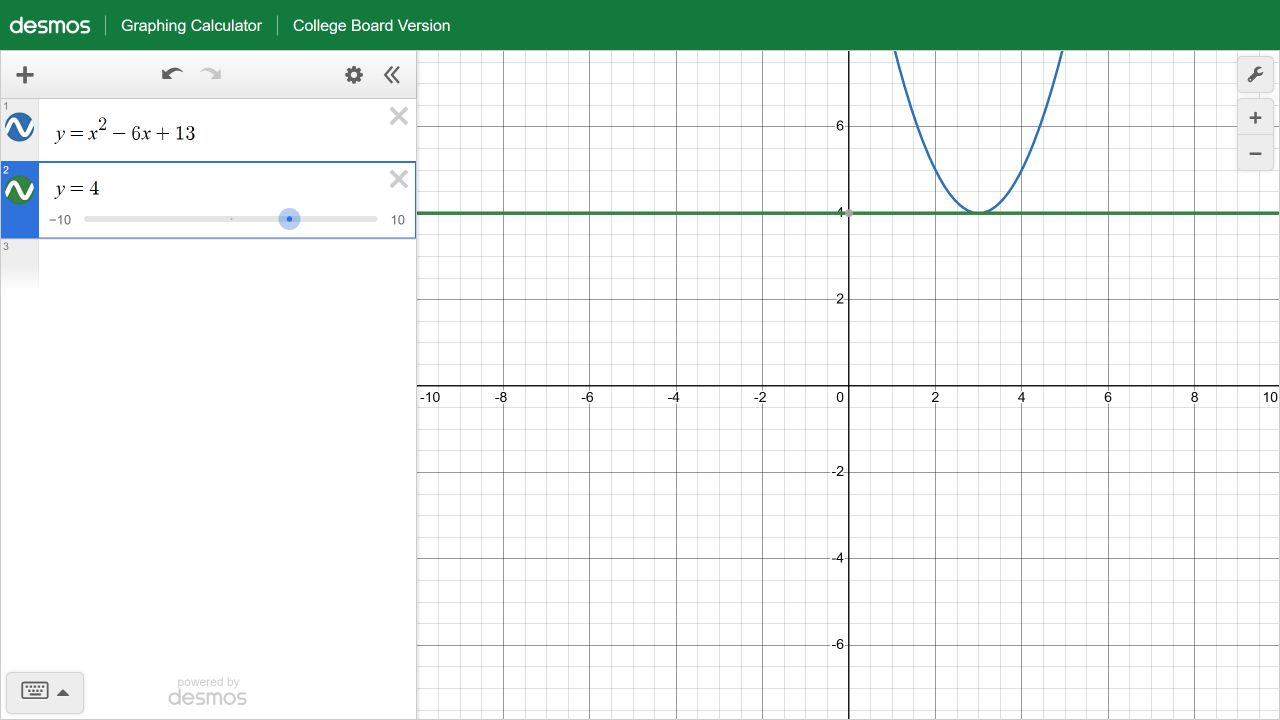
Graph the quadratic. Its minimum appears at (3, 4).
A horizontal line below the minimum has no intersections; above it, two. The line through the minimum touches once.
Enter y = 4 to check that proposed value.
Confirm the exact value algebraically; a slider or a close-looking graph alone does not establish exact tangency.
There is exactly one real x only when the right-hand side is 0. Thus k = 4 and x = 3.
Watch for this: The parameter k is the height of the horizontal line, not the x-coordinate of the vertex.
Radical equations: reject the extra root
Solve √(x + 6) = x over the real numbers.
Why this approach works
Graphing the original sides tests the original equality directly. Every intersection must have the same output on both sides, including the requirement that a square root be nonnegative.
Squaring preserves true equalities but can also make unequal numbers equal: 2 and −2 have the same square. That is why the squared equation provides candidates, not automatically valid answers. Substitution into the unsquared equation removes the extra candidate.
Enter these on separate lines
y=\sqrt{x+6}
y=x
Do this step by step
Graph the original two sides, rather than only a squared version.
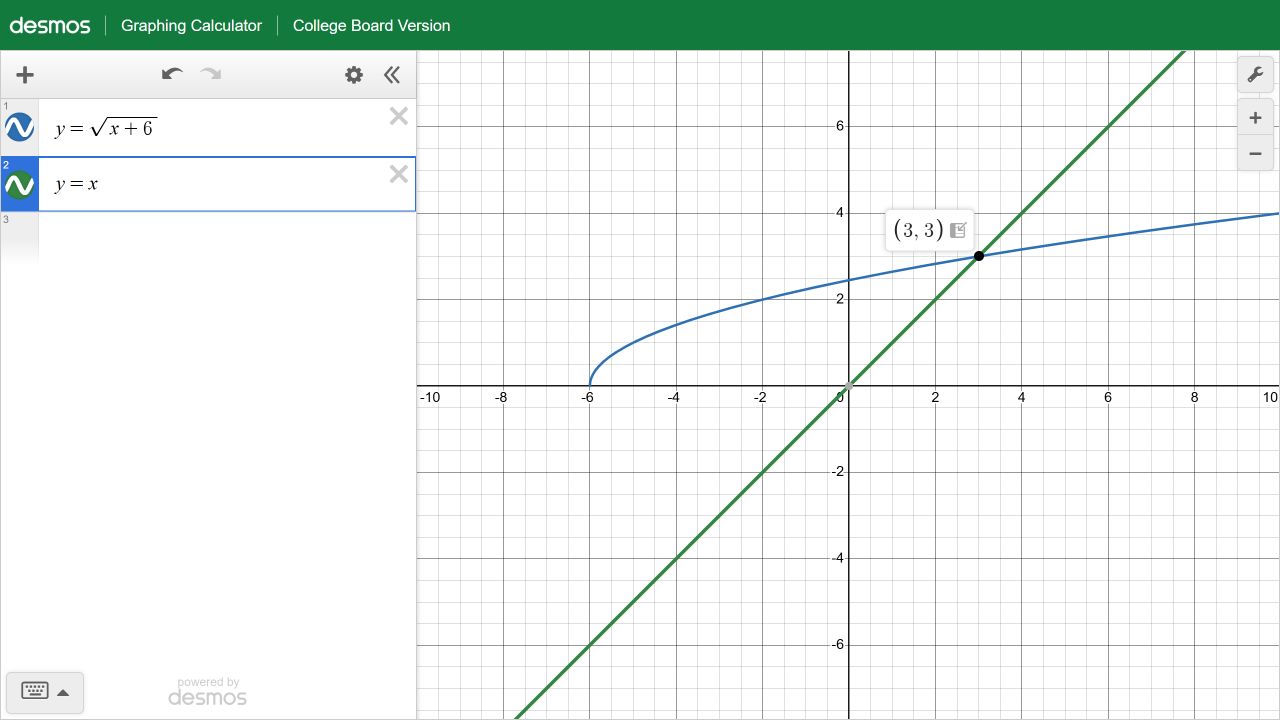
The curves meet at (3, 3), suggesting x = 3.
The radical requires x ≥ −6. Its nonnegative output also means a solution must satisfy x ≥ 0.
Check algebraic candidates in the original equation.
Factor x² − x − 6 = (x − 3)(x + 2) = 0, giving candidates 3 and −2.
For x = 3, √9 = 3, so it works.
For x = −2, √4 = 2, which is not −2. Reject −2.
Watch for this: Squaring can create candidates that were not solutions of the original equation.
Rational equations: keep the excluded values
Solve 1/(x − 2) = 3/(x + 2).
Why this approach works
Both sides are functions with excluded inputs. An intersection at an allowed x gives the same fraction value on both sides, which is the equation we want to solve.
Multiplying by the product of the denominators removes the fractions only after we restrict ourselves to inputs where that product is nonzero. Keeping x ≠ 2 and x ≠ −2 prevents an invalid cancellation or an undefined value from becoming an answer.
Enter these on separate lines
y=\frac{1}{x-2}
y=\frac{3}{x+2}
Do this step by step
Before calculating, exclude x = 2 and x = −2 because they make a denominator zero.
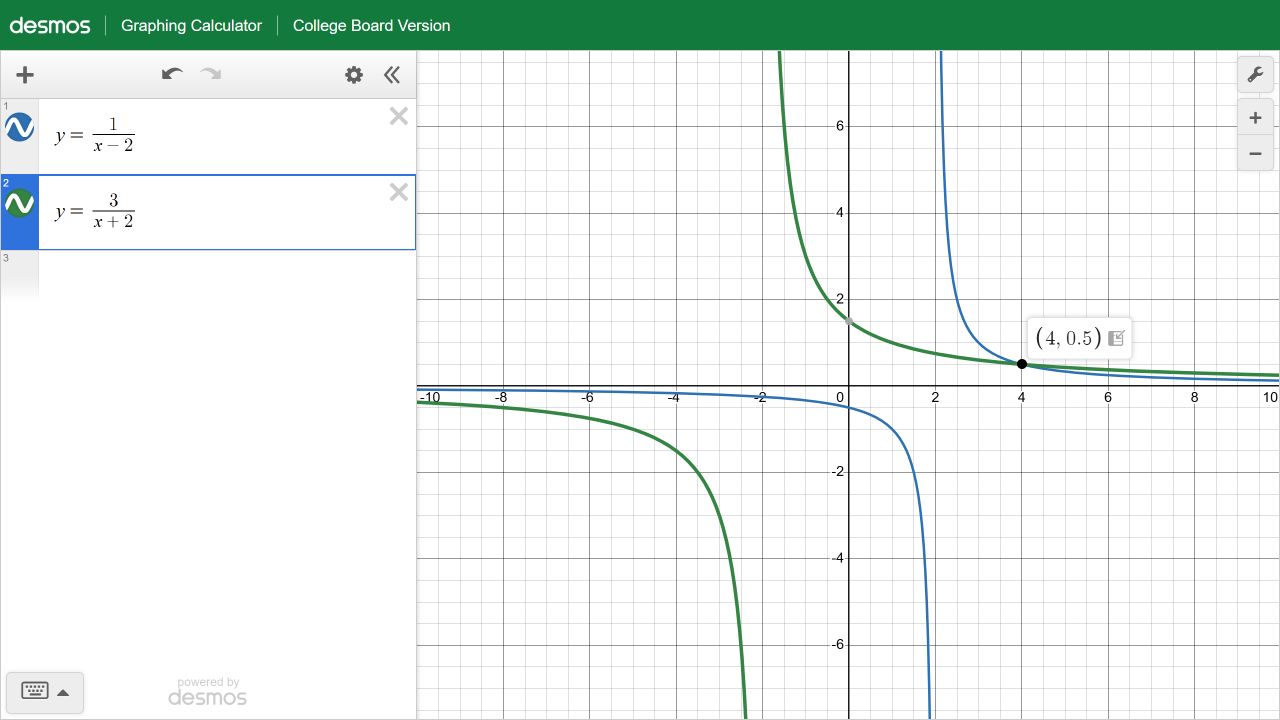
Graph the original sides. Their intersection is (4, 0.5).
Take the x-coordinate, 4, as a candidate and substitute it into both original fractions.
For allowed x-values, multiply by (x − 2)(x + 2): x + 2 = 3(x − 2).
Expand to x + 2 = 3x − 6, hence 8 = 2x and x = 4.
At x = 4, the left side is 1/2 and the right side is 3/6 = 1/2. Neither denominator is zero.
Watch for this: A vertical asymptote is not an intersection. Do not cancel a denominator without keeping its domain restriction.
Transformations: follow the input before the output
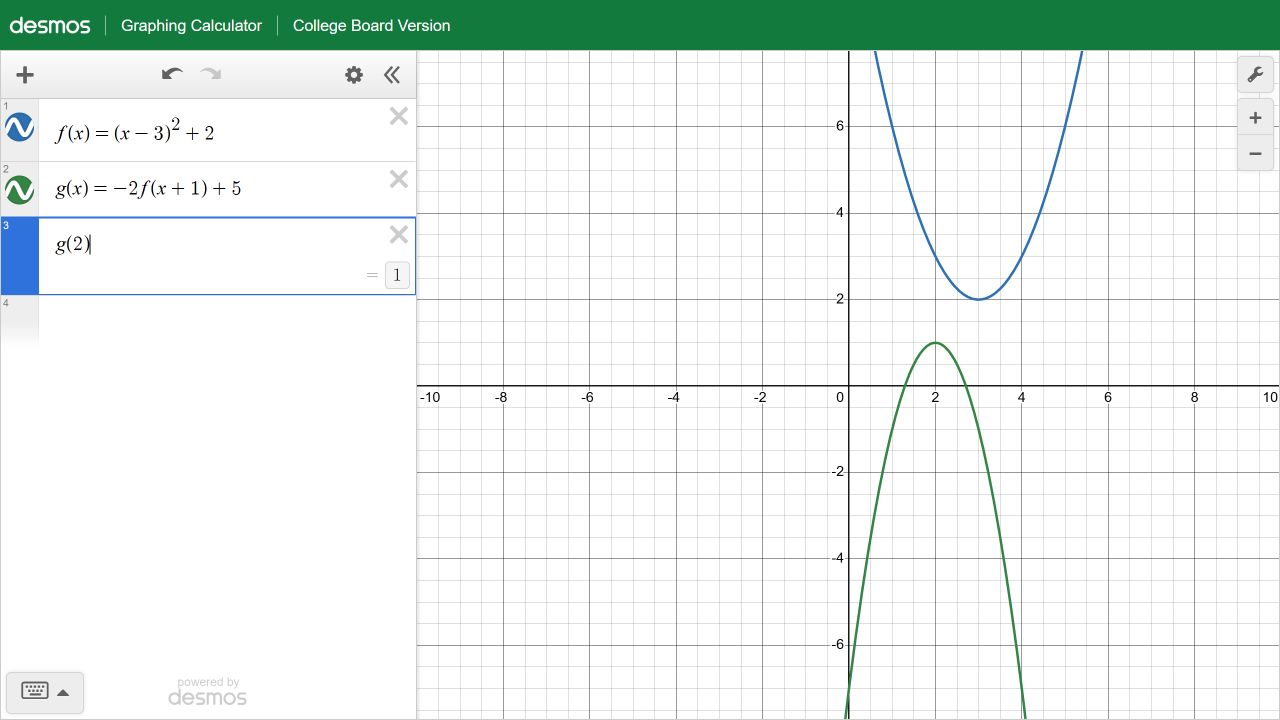
f(x) = (x − 3)² + 2 and g(x) = −2f(x + 1) + 5. Find the vertex of g.
Why this approach works
Function notation describes the order of operations. g(x) first feeds x + 1 into f, then multiplies f’s output by −2, then adds 5. Working in that order keeps input changes separate from output changes.
To reach f’s original vertex input 3, the new input must satisfy x + 1 = 3, hence x = 2. Its original height 2 becomes −2(2) + 5 = 1. The negative multiplier turns the upward-opening minimum into a downward-opening maximum.
Enter these on separate lines
f(x)=(x-3)^2+2
g(x)=-2f(x+1)+5
g(2)
Do this step by step
Define f first, then define g using the given function notation.
The x + 1 inside f shifts its graph left by 1. The original vertex’s x-coordinate moves from 3 to 2.
The outside −2 reflects and vertically stretches the output; +5 then moves it up.
The new vertex is (2, 1). The calculation g(2) = 1 checks its height.
This is vertex form, so the vertex is (2, 1). The negative leading coefficient makes it a maximum.
Watch for this: Inside changes act on the input. f(x + 1) shifts left, not right.
Inequalities: use the overlapping region
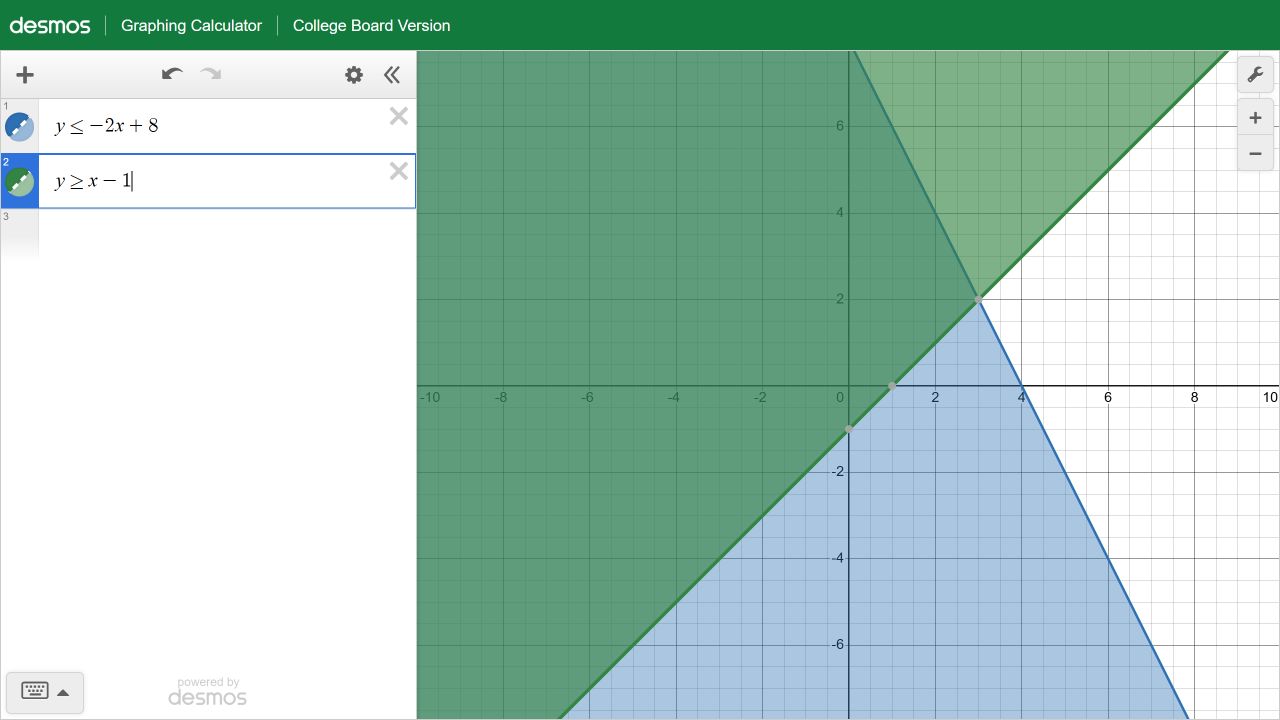
A point satisfies y ≤ −2x + 8 and y ≥ x − 1. What is the greatest possible x-coordinate?
Why this approach works
Each shaded half-plane is the set of points satisfying one inequality. A point must be in their overlap because both conditions must hold simultaneously.
For a feasible y to exist, its lower bound x − 1 cannot exceed its upper bound −2x + 8. Comparing those bounds gives x ≤ 3. At x = 3 the bounds agree at y = 2; since equality is allowed, the greatest x is actually attained.
Enter these on separate lines
y\le -2x+8
y\ge x-1
Do this step by step
Enter both inequalities, keeping the “or equal to” parts.
Find the region that satisfies both shadings: above y = x − 1 and below y = −2x + 8.
The rightmost boundary occurs where the lines meet at (3, 2).
Because both inequalities include equality, that boundary point is allowed.
At x = 3, both bounds give y = 2, so the bound is attainable.
Watch for this: A point in only one shaded region does not satisfy the system. With strict inequalities, an endpoint may not be included.
Equivalent expressions: matching graphs are not the whole proof
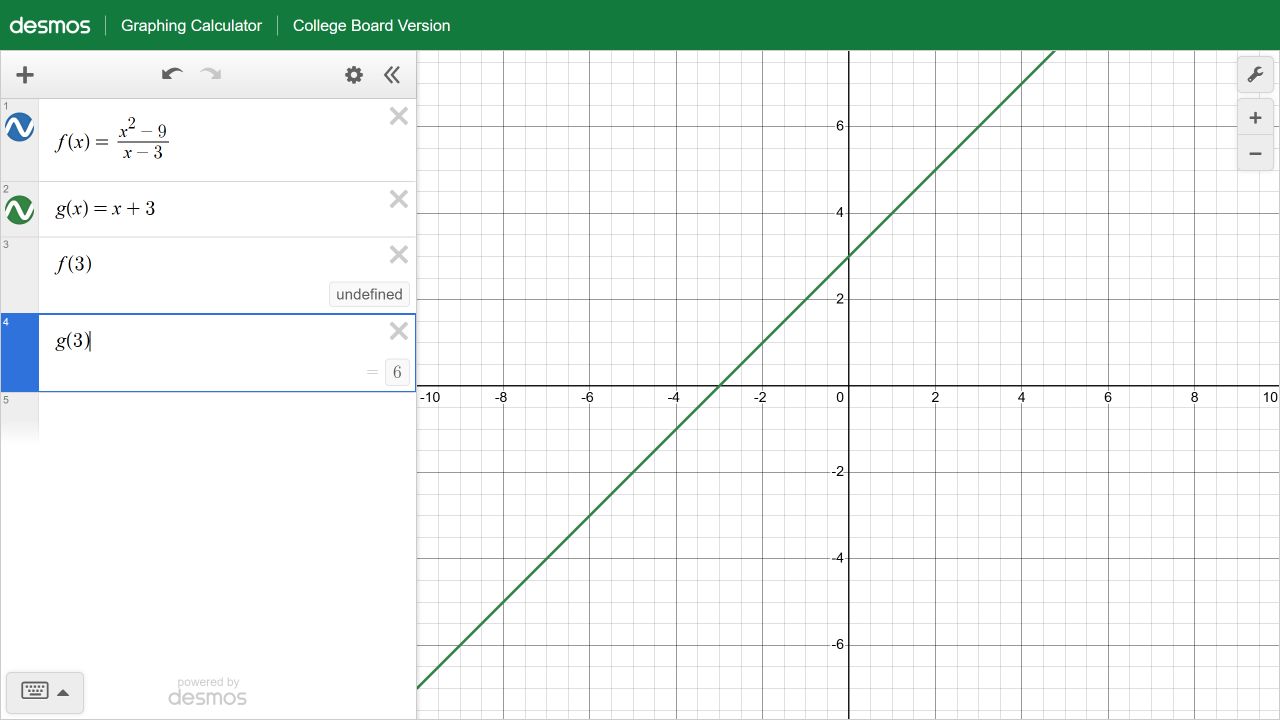
Are f(x) = (x² − 9)/(x − 3) and g(x) = x + 3 the same function on all real numbers?
Why this approach works
Two formulas can produce the same values at nearly every visible point and still define different functions if their domains differ. A graph has limited resolution and may not draw a visible hole.
The cancellation removes a factor only where that factor is not zero. At x = 3 the original fraction is undefined, while x + 3 remains defined. Algebra plus a direct evaluation of the excluded input explains a difference that an overlapping graph can hide.
Enter these on separate lines
f(x)=\frac{x^2-9}{x-3}
g(x)=x+3
f(3)
g(3)
Do this step by step
Graph both functions. They appear to overlap.
Evaluate both at the value excluded by the fraction’s denominator, x = 3.
The calculator reports f(3) as undefined but g(3) = 6.
Explain the domain difference instead of treating a matching screen as proof of identical functions.
Cancel x − 3 only when x ≠ 3. Thus f(x) = x + 3 on that restricted domain.
g is defined at every real x; f is not defined at 3. They agree wherever f is defined, but they are not the same function on all real numbers.
Watch for this: Desmos may not automatically display a visible hole. Testing a few points can disprove an identity, but cannot establish it for every allowed input.
Now you do it: three guided problems
These are intentional drills of the methods above, with different numbers. Work in Desmos first. Use a hint if you get stuck; every solution step is available afterward. These checks are ungraded.
You try: which coordinate?
For y = x² − 2x − 3 and y = x + 1, find the larger y-value at an intersection.
Your steps
Open a fresh calculator so old definitions do not interfere. Enter the two lines.
Click each crossing and write down both ordered pairs on paper.
Circle the y-coordinate in each pair. Enter the larger y-value below.
Show the setup inputs
y=x^2-2x-3
y=x+1
Give me a hint
Set the two expressions for y equal, or inspect the intersections near x = −1 and x = 4.
Show every solution step
Set x² − 2x − 3 = x + 1.
Rearrange: x² − 3x − 4 = (x − 4)(x + 1) = 0.
x = 4 gives y = 5; x = −1 gives y = 0.
The larger y-value is 5.
In a different question asking for the sum of the x-coordinates, the answer would be 4 + (−1) = 3.
You try: exactly one real solution
Find k so x² − 8x + 25 = k has exactly one real solution.
Your steps
Graph the quadratic. Zoom out once if its vertex is above the initial window.
Find the lowest point and record its ordered pair.
Enter a second expression y = your proposed k. Check that it touches once, then justify the exact value by completing the square.
Show the setup inputs
y=x^2-8x+25
Give me a hint
Rewrite x² − 8x + 25 as (x − 4)² plus a constant. k is a height.
Show every solution step
x² − 8x + 25 = (x − 4)² + 9.
Then (x − 4)² = k − 9.
Exactly one real solution requires k − 9 = 0.
k = 9, with the single solution x = 4. The check line is y = 9.
If k = 10, the solutions are x = 3 and x = 5. If k = 8, there are no real solutions.
You try: check the original equation
Solve √(x + 12) = x. Enter the valid real solution.
Your steps
Graph the original sides and identify their crossing.
Separately square the equation and factor the resulting quadratic. Write down both candidates.
Substitute each candidate into the original square-root equation. Enter only the one that works.
Show the setup inputs
y=\sqrt{x+12}
y=x
Give me a hint
The squared equation factors as (x − 4)(x + 3) = 0. A square root cannot equal a negative number.
Show every solution step
Square to obtain x + 12 = x².
Factor x² − x − 12 = (x − 4)(x + 3) = 0.
At x = 4, √16 = 4, so it works.
At x = −3, √9 = 3 ≠ −3. Reject it. The valid solution is 4.
State the domain before squaring: x ≥ −12 is required for the radical, and any solution of this equation must also have x ≥ 0.
When to stop using the graph
A graph can suggest roots, a maximum, or a parameter value. Check exact values with algebra, keep excluded inputs, and make sure the window has not hidden another solution. Keep intermediate precision and round only as requested.
Sources and calculator notes
Desmos documents regression models, residuals, the effect of Log Mode and numerical fitting limitations. Its testing calculators can differ from the general calculator. College Board includes nonlinear equations, functions and systems in SAT Advanced Math. The examples and algebra here were independently worked for this lesson.